
Proofs, production time and the money around a custom order
From the seller’s first mock-up to the parcel: what a proof should show, how to approve it, how 100buy follows up with sellers while the work is done, and what the whole order costs.
Proofs, mock-ups and the approval message
A proof is the seller’s picture of what they are about to make: your design placed on a flat drawing or photo of the item, usually with its size written beside it. Some sellers call it a mock-up or an effect picture. It costs the seller a few minutes and saves both sides from the most common custom-order argument, which is “that is not where I wanted it”.
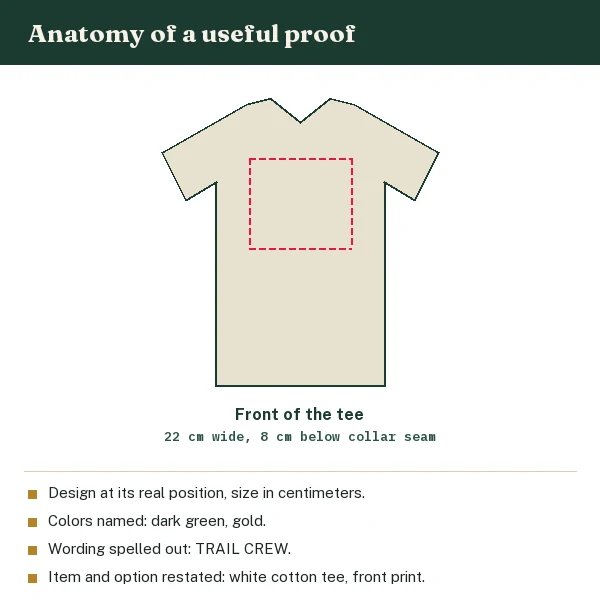
A useful proof shows five things: the design at its real position, the size in centimeters, the colors named or swatched, the wording spelled out, and the item and option you ordered. If any of those is missing, ask for it before approving. A pretty picture without numbers is a sales image, not a proof.
For orders of more than a few pieces, ask for one more step: a photo of the first finished piece before the rest are made. Not every seller agrees, and some charge for it, but when they do, it is the closest you can get to watching the machine yourself.
Reading a proof before you say yes
Read a proof the way a proofreader reads a page: slowly, one element at a time, against your own brief. Spelling first, letter by letter, out loud if it helps. Then the numbers: is the width the one you asked for, is the distance from the seam right, is the quantity and size split restated correctly.
Then the parts a proof can only hint at. Colors on a mock-up are screen colors; ask about the actual ink or thread if the shade matters. Texture, thickness and how a print feels are invisible. A proof also cannot show how a design wraps over a seam, so if your design runs close to one, ask the seller directly.
If something is wrong, reply with one message listing every change, numbered. Several small messages arriving over a day invite the seller to act on the first and miss the rest.
The approval message, word for word
Approve in writing, and make the approval specific enough that it could settle a disagreement later. “OK” approves whatever the seller thinks you saw. “Approved: proof of 19 October, design 22 cm wide, 8 cm below the collar seam, dark green and gold, wording TRAIL CREW, six pieces S 1 M 2 L 2 XL 1” approves exactly one thing.
Keep the proof image and your approval message together, along with your original brief. Those three items are the record of what you asked for and what the seller agreed to make. If the finished piece differs from the approved proof, they are what you will point to.
Budget for at most one round of changes. A second proof is normal; a fourth suggests the design was not ready, and the seller’s patience and the calendar both run out.
Lead times for finished-to-order goods and the follow-up rhythm
100buy’s seller dispatch FAQ says domestic sellers generally ship within 3 to 7 days, and the same line excludes some customized items from that figure. That exclusion is the honest answer: custom work runs on the seller’s own schedule, so the number that matters is the one the seller gives you in writing before you pay.
Ask for it as days of work after the proof is approved, not as a delivery date, because the domestic trip to the warehouse and the international parcel come afterward.
Once an order is placed, 100buy’s shopping agent service disclaimer describes a follow-up rhythm with sellers: if an order has not shipped within three days, the agent follows up with the seller for the first time on the fourth day and then every three to four days. If the seller never ships or stops replying, the agent asks you to cancel. When a seller says an item has run out, you have 72 hours to answer before the agent cancels on your behalf.
For a custom order with a week of agreed work, the early follow-ups are routine and not a sign of trouble.
Following up without slowing the order
The best follow-up is the one you never need to send because the brief and the approval were complete. When you do need to ask, keep it in the same conversation, refer to the approved proof, and ask one question: “Is the order still on track for the agreed seven days of work?”
Answer quickly when the seller or the agent asks you something. A question about a thread color or a font left unanswered for a weekend can stop production, and an out-of-stock notice left unanswered for three days ends the order. If you will be away, say so in your brief.
Resist changing the design after approval. A new file sent mid-production either gets ignored or restarts the work, and either way the agreed timing no longer applies. If a change is essential, ask first whether production has started.
Storage once the finished piece arrives
Custom pieces often reach the warehouse later than everything else in the same haul. 100buy’s Storage page counts its free period, 90 days, from when an item’s status turns to received, so storage for a custom piece starts on arrival, not on the day you ordered.
That makes it easy to wait for a custom piece and send it with your other items in one parcel. The one thing not to postpone is checking it. Look at the warehouse photos as soon as they appear and ask for close-ups at once, because the window for raising problems with the seller starts at stock-in and is short.
The returns page covers that window and the photos in detail. The short version: storage is generous, the time to object is not.
What a custom order costs, line by line
Here is where the money goes in a custom order, layer by layer. First the item price, which on custom listings usually includes the work through the option you choose: a print, a name, an engraving. Then the seller’s domestic shipping to 100buy’s warehouse, if the listing charges it. According to 100buy’s Service & Fees page, buying from the common marketplaces adds no handling fee (checked 19 October 2026); the order summary lists the final lines before you pay and is where to confirm it.
Optional extras sit on top. Detail photos are priced per photo on 100buy’s value-added page, and customized warehousing jobs are quoted on inquiry.
A custom-work budget begins with the named proof version and the scope of the quote. Ask whether setup, a sample and revisions are included before paying; a catalog base price cannot supply those answers. Keep each converted payment with the corresponding approved work in the custom-order cost record.
Payment and import costs finish the list. On its PayPal page, 100buy puts the charge at 4.5 percent plus $0.30. Customs duties and any fines are the buyer’s to bear; declare the real value of what you ship.
The exchange rate inside 100buy’s displayed prices
100buy prices goods and shipping in Chinese yuan and shows them in your chosen currency. That conversion carries its own margin, which is worth knowing before you compare a custom quote with a maker at home.
If the seller changes the specification or production schedule, ask whether the quote changes too. Keep that agreement separate from the later parcel estimate. This prevents a revised production charge being mistaken for an exchange-rate movement or an international shipping adjustment.
A past display-rate comparison does not establish the current conversion. Record the same CNY total and the actual foreign-currency debit at payment, including any disclosed charges. Do not add an old percentage to a price that already includes conversion.