
Custom work, finished-piece photos and the rule against returning it
A piece made to your instructions cannot go back on the shelf. What 100buy’s return page says about custom work, and how to see the finished piece clearly before it leaves the warehouse.
Custom work and the rule against returning it
100buy’s return and exchange page sorts products into those eligible for its five-day return and exchange guarantee and those that are not. Two rows on the ineligible side matter here. The first is custom-made goods, with “products of tailored designs” as the example. The second covers goods that had their tags, packaging or accessories taken off because the buyer asked.
For goods in those rows, the page says 100buy will still negotiate with the seller after receiving your request, but the final result is the seller’s decision. In plain terms: you can ask, and 100buy will carry the request, but nothing obliges the seller to take back a hoodie with your name on it.
The logic is easy to see from the seller’s side. A stock item that comes back can be sold to the next buyer. A tee printed with your drawing, a ring engraved with your date or jeans cut to your leg cannot. That is why every page on this site pushes the checking forward, to the brief and the proof, where it costs nothing.
The approved proof as the yardstick
Because a custom piece cannot simply go back, the useful question when it arrives is narrower: does it match what you approved? A finished hoodie with the print where the approved proof put it, at the approved width, in the approved colors, is the order you placed, even if it looks different from what you imagined.
A finished piece that departs from the approved proof is a different matter, and worth raising with the seller through 100buy. Raise it quickly. For eligible items, 100buy’s return page runs the request clock for 120 hours, beginning at the first full hour that follows the “Stocked in” status, and while custom pieces fall outside that guarantee, a request sent within the same window is simply easier for everyone to act on.
Lay the warehouse photos next to the approved proof and compare the same five things you checked on the proof: spelling, size, position, colors, quantity. Any difference you can point to in a photo is something the seller can see too.
Seeing the finished piece before it ships
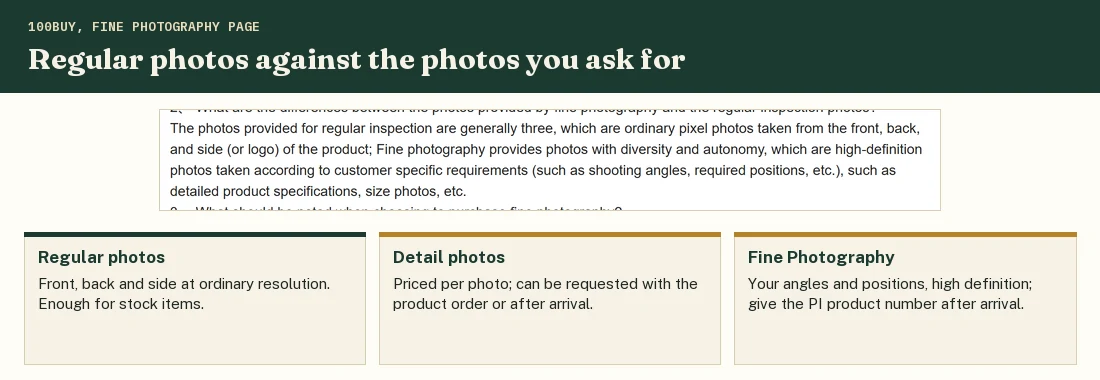
When an item reaches the warehouse, 100buy’s Inspection Information page says staff check quantity, color and size against what you ordered. The Fine Photography page describes the regular inspection set as generally three photos at ordinary resolution, taken from the front, from behind and from one side. For a stock tee that is often enough. For a custom piece it rarely shows what you need to see.
Two paid options fill the gap. Detail photos are listed on the value-added page at 1 RMB each, described as extra photos of details or local measurements, and can be requested after the item arrives or at the time you submit the product order. Fine Photography takes high-definition photos to your stated angles and positions; for items already in the warehouse, the page says you must give the PI product number and check that your requirements match the number of photos.
Asking for detail photos at the ordering stage
The value-added page lists a detail photo row for requests “submitted during product order”. For custom work that is the most useful line on the page: you can describe the photos you will need while you are writing the brief, and they are taken when the piece arrives, without a separate round of messages.
Ask for photos that answer measurable questions. A close-up of the print with a ruler laid across it. The embroidered letters filling the frame. Engraving shot at an angle under light so the letters read. A trouser hem with a tape measure running up the inside leg. Each one turns a vague worry into something you can check.
Keep the request short and numbered, and name the item it applies to if your order has several. The warehouse handles many items a day, and a numbered list is easier to follow than a paragraph.
Reading the QC photos of a custom piece
Start with a sharp, close photograph of the wording. Compare it letter by letter with the approved proof, then check a wider view for position and scale. Blurred, angled or partly covered lettering remains unresolved; no photograph is guaranteed to show spelling clearly.
Then size and position. A ruler in the frame makes width a matter of reading a number. Without one, compare the design against something of known size in the same photo, such as the width of a cap’s brim seam or the collar of a tee. Color comes last, because warehouse lighting shifts it; ask about the shade only if the difference is large.
Photos cannot tell you how a print feels or how well a stitch will wear. Those are the limits of any inspection at a distance, and the reason a seller with a good record of finished pieces is worth choosing in the first place.
When the finished piece does not match the proof
If the warehouse photos show a clear departure from the approved proof (a misspelling you did not write, a design noticeably smaller than approved, the wrong thread color), contact 100buy promptly with three things: the approved proof, your approval message and the photo showing the difference. Ask them to raise it with the seller.
What happens next is the seller’s call, as 100buy’s return page makes clear for custom-made goods. Sellers handle these requests in different ways, and this site does not try to predict them. Do not submit the item in a parcel while the conversation is open; once it ships, there is nothing left to discuss.
If the finished piece matches the proof and you simply like it less than you hoped, the honest answer is that it is yours. Use what you learned in the next brief.