
Engraved letters and lengths cut to your measurement
Two kinds of custom work that cannot be undone: letters marked into metal and fabric or straps cut to a length. Both succeed or fail on how precisely you write the instruction.
Engraving on metal and the character limit
Most engraving on catalog jewelry is done with a fiber laser, the kind designed for marking bare metal. Equipment makers’ own pages, such as a laser maker’s page on marking metal, describe these lasers marking stainless steel, titanium and precious metals without any coating, either by removing a fine layer or by darkening the surface with heat.
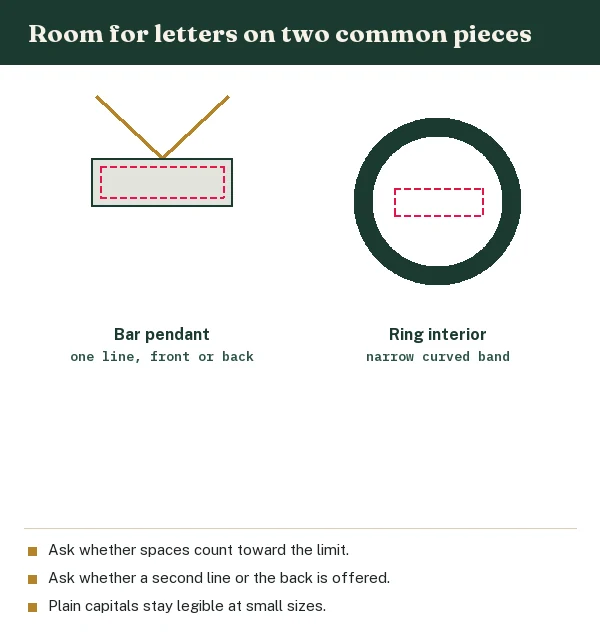
What limits you is the surface, not the laser. A bar pendant has room for a short line; the inside of a ring has a narrow band that curves away from the lens; a tag might fit two lines. Custom listings usually state a maximum number of characters, and the useful questions are whether spaces count, whether there is a second line, and whether capitals take more room.
Font choice matters more than it seems. Thin script looks lovely in a mock-up and can blur at ring size. A simple serif or sans serif in capitals stays legible on the smallest surfaces. If the listing offers fonts by number, write the number and the font’s look (“font 3, plain capitals”), in case the menu changes.
Spelling that survives a translation tool
Engraving is spelled exactly as received, and between you and the engraver sits a translation step. Names, dates and short phrases are fragile in that crossing. Translation tools sometimes “correct” an unusual name, change capitals, drop an accent or turn an ampersand into the word “and”.
Send the wording as typed text, never as a photo or a screenshot, and put it on a line by itself. Then describe anything unusual in words: “the second letter is a lowercase e with an acute accent”, “there is an apostrophe before the s”, “keep the two spaces between the names”. That second description survives even if the first line gets mangled.
Dates deserve special care. 10/09 is October 9th in the United States and 10 September in much of the world. Write dates the way they should appear on the metal, and add the date in words underneath so nobody has to guess.
Cut-out names and letter pendants
Not every name necklace is engraved. Many are cut: the whole name is sawn or laser-cut from flat metal stock as one piece, and the letters themselves become the pendant. Others are built from separate letter charms threaded onto a chain. The jewelry card on the home page shows both styles.
Cut names have their own failure points. Joined script letters need enough metal where one letter meets the next, so very thin strokes or long names may be redrawn or thickened by the seller. Small loops in letters like “e” and “a” can fill in or snap if the metal is thin. Ask for a proof that shows the name at its real size, not a zoomed-in mock-up.
Give the letter height or the overall width you want, the metal finish, and the chain length, measured as the next section describes. For charm-style pendants, list every charm in order, including spaces, so the count is unambiguous.
Cut-to-order hems, sleeves and strap lengths
Some listings offer to cut a garment or an accessory to a length you give: jeans and trousers hemmed to your leg, sleeves shortened, a bag strap or a chain made to a set length. This is custom work in the plainest sense, and it fails for one reason more than any other: the seller measured from a different starting point.
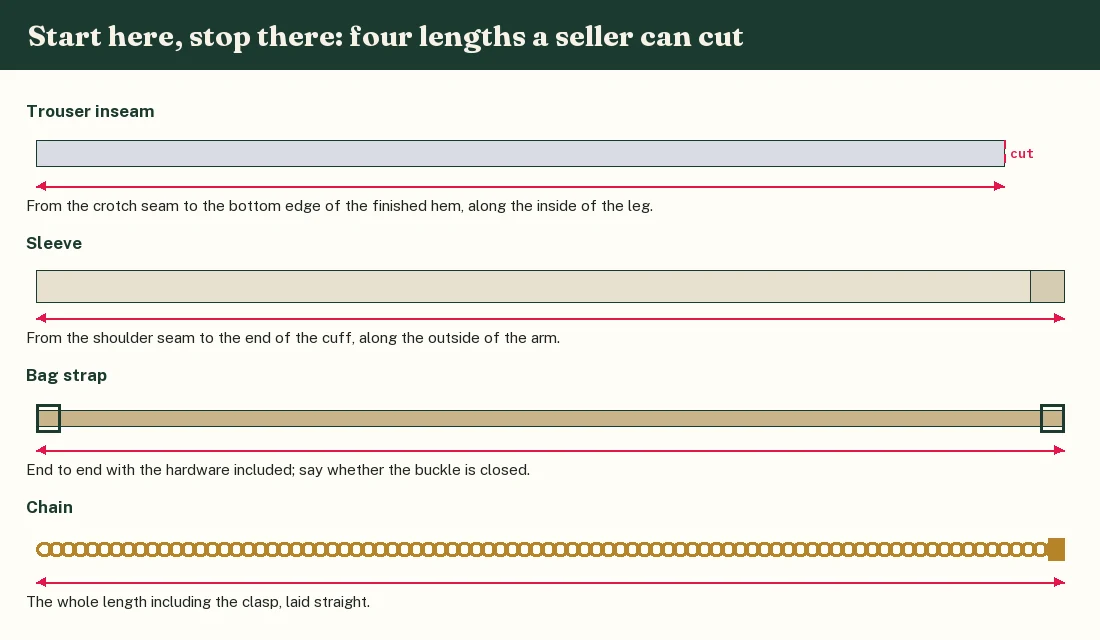
So never send a single number on its own. Send the finished length, say where the tape starts and ends, and say how you measured it. “Inseam 76 cm, from the crotch seam to the bottom edge of the hem, measured on jeans I own laid flat” leaves nothing to interpret.
For sleeves, the usual reference is the shoulder seam to the end of the cuff, along the outside of the arm. For straps, give the length end to end with the hardware included, and say whether the measurement is with the buckle closed. For chains, give the length including the clasp.
Expect a tolerance. Hand cutting and hemming usually land within a centimeter of the number, so give the length you want, not the shortest you can tolerate.
Finished length, not a different size
A cut length is an instruction about one dimension of a garment you have already chosen. It does not change the size label, the waist or the fit, and this site does not try to help with choosing a size: a seller cannot fix a waist with scissors.
The most reliable way to arrive at a finished length is to measure something you already own and like. Lay the trousers flat, smooth the leg, and measure along the inside seam. Do the same for a jacket sleeve. Write down the number and the starting point in the same sentence, so they cannot become separated.
Avoid relative instructions such as “shorten by 5 cm”. Shorten from what? The seller does not know the length of the garment you will receive, which may differ from the listing photo. A finished length always means the same thing.
Belts, straps and chains cut to measure
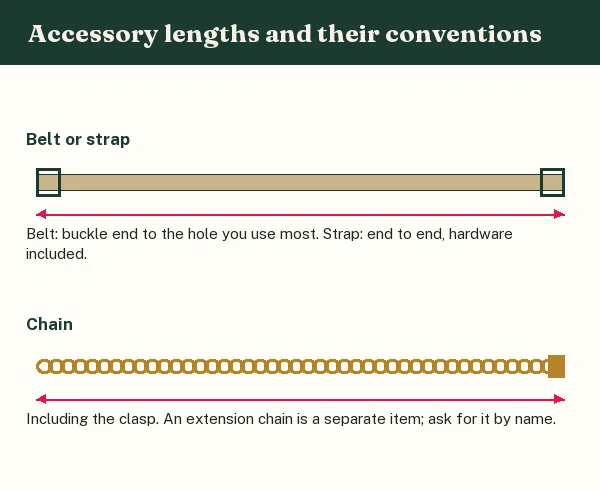
Accessories have their own small conventions. Belts are often sold in a length to be cut: the usual instruction is the measurement from the end of the buckle to the hole you use most on a belt you already wear. Some sellers prefer your waist measurement instead; follow what the listing asks for and say which one you gave.
Bag straps vary in where the measurement starts. Give the length end to end including clips and rings, and say whether you want it adjustable and, if so, the shortest and longest settings. For chains, the length including the clasp is the usual convention, and an extension chain is a separate item worth mentioning if you want one.
Whatever the item, add one line saying how you measured. That line costs nothing and turns a guess into an instruction.
What engraving and cutting cannot undo
An engraved name cannot be polished away cleanly, and a hem cannot be lengthened once the fabric is cut. That permanence is the whole point of the work and also its risk. Once the seller starts, a mistake in your instruction becomes a permanent feature of the item.
100buy’s return page lists custom-made goods among the items its return guarantee does not cover, and pieces altered at the buyer’s request fall into the same group. What that means in practice, and how to see the finished piece before it ships, is covered on the returns page.
The practical response is simple: confirm the spelling and the length twice, once in your brief and once on the proof, and keep both messages. If the seller made something other than what the approved proof shows, that is a conversation you can have. If the seller made exactly what you approved, it is yours.